
In development
Orisdale Workflow Agent for Alteryx — BigQuery Edition
Reviewable Alteryx workflows from agreed requirements.
Workflow generation turns agreed requirements and source evidence into an artifact the author can inspect before import.
In development for Alteryx and BigQuery. The full delivery journey describes the product direction; current scope is outlined below.
How the Workflow Agent works
A one-minute film that follows one finance rule: written in plain words, approved by a named person, then built and delivered.
Workflow authoring, one part of the journey
This illustration shows agreed requirements becoming a reviewable Alteryx artifact. It does not depict the full seven-stage product. The sequence holds at author review.
Example authoring view. Status: In development.
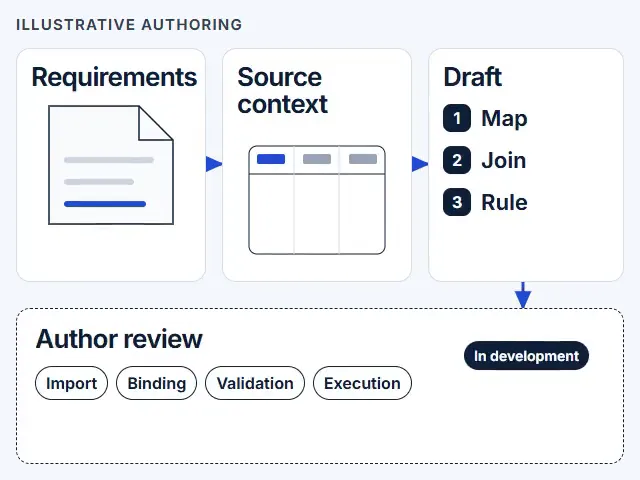
Requirements, source context, and a draft stop at author review. Import, binding, validation, and execution stay with the author.
Technical workspace
The graph names each step in the same journey.
Requirements and evidence
Supplied by the author
- Source lineageSource lineage and prepared dataBranch from an earlier stepSource evidence to Source inputThe evidence describes the source that the input step reads.
Proposed workflow artifact
Generic steps, not native tool identities
- Prepared recordsSource lineage and prepared dataSource input to Prepare fieldsThe input step feeds the step that prepares fields.
- Rule lineageRule lineage from a requirementBranch from an earlier stepApproved requirements to Apply approved ruleThe requirement states the rule that the rule step carries.
- Shaped fieldsSource lineage and prepared dataPrepare fields to Apply approved ruleThe prepared fields feed the rule step.
- Rule resultSource lineage and prepared dataApply approved rule to Expected output definitionThe rule step produces the result table.
- Artifact for reviewAuthor review and validationExpected output definition to Author reviews the artifactThe proposed artifact goes to the author for review. It has not been run.
Review and validation
Owned by the author
- Author decidesAuthor review and validationAuthor reviews the artifact to Import, bind, validate, executeOnly the author decides to import, bind, validate, and execute.
Source evidence
The author provides the evidence that describes the sources the workflow reads. The evidence stays attached so a reviewer can see what the specification used.
Approved requirements
The author starts from requirements that were approved before preparation begins. Each rule step points back to one.
Source input
A step that reads the source the evidence describes.
Prepare fields
A step that shapes the fields the requirements ask for.
Apply approved rule
A step that applies a rule the requirements state. The rule comes from a requirement, not from the model.
Expected output definition
The output the requirements describe. Preparing it does not run the workflow.
Author reviews the artifact
The author inspects the artifact, the traces, and any unmet requirement.
Import, bind, validate, execute
The author imports the artifact into Alteryx, binds it to real sources, validates it, and decides when to run it.
- Requirements and evidenceThe author supplies approved requirements and the source evidence the workflow must respect.
- Proposed generic workflowA proposed workflow graph, shown as generic steps, each traced to a requirement or to evidence.
- Author reviewThe author inspects the proposed artifact and its traces before anything is imported.
- Author-owned validation and executionImport, binding, validation, and execution stay with the author. Preparing the artifact does not run it.
- Source lineage and prepared data
- Rule lineage from a requirement
- Author review and validation
Every relationship as text
- Source evidence to Source input (data or result): The evidence describes the source that the input step reads.
- Approved requirements to Apply approved rule (workflow, query, or policy): The requirement states the rule that the rule step carries.
- Source input to Prepare fields (data or result): The input step feeds the step that prepares fields.
- Prepare fields to Apply approved rule (data or result): The prepared fields feed the rule step.
- Apply approved rule to Expected output definition (data or result): The rule step produces the result table.
- Expected output definition to Author reviews the artifact (human review): The proposed artifact goes to the author for review. It has not been run.
- Author reviews the artifact to Import, bind, validate, execute (human review): Only the author decides to import, bind, validate, and execute.
Who it is for
- Intended user
- Designed for forward deployed engineers, solution engineers, and implementation teams delivering data solutions. A business leader asking a governed question uses a business-facing decision experience. On this site that experience is an example interface or a reference design, not a separate released product.
- Requirements and source inputs
- The author supplies the requirements and the source evidence. This site does not store those datasets.
- Reviewable output
- A workflow artifact the author can inspect before any import.
- Human responsibilities
- Today a person controls import, binding, validation, and execution in Alteryx. That is the current boundary. It is not a decision that execution must stay manual.
See Alteryx One and the reference architecture.
Product direction
The intended product carries a business request through source evidence, agreed rules, a native implementation, an authorized run, and verification that can be repeated when the rule changes. Workflow generation is the central capability inside that direction.
Current scope
- A person controls import, binding, validation, and execution. That is the current boundary, not a permanent decision that execution must stay manual.
- If execution is added later, it still runs through an authorized platform path.
- Workflow authoring is one part of the intended journey.
Questions
What is the current scope?
Alteryx One and BigQuery. A person still controls import, binding, validation, and execution. That is the current boundary, not a promise that execution stays manual forever.
How mature is it?
In development. Product direction covers the wider delivery journey. Current scope is the authoring boundary described on this page.
What data does it require?
The author supplies the requirements and the source evidence. This site does not store those datasets.
Where does a person review the work?
The author inspects the artifact and decides when to validate and execute.
What is the next step?
Request a Strategy Session on the contact page.