
Reference design
Energy intelligence for governed operational decisions
A reference design for drilling performance and contracts, land and lease obligations, and operational health. The patterns are examples. They are not customer deployments and they do not report measured savings.
A documented design: the data, rules, architecture, controls, and review steps a build would follow. Not a delivered system or a customer deployment.
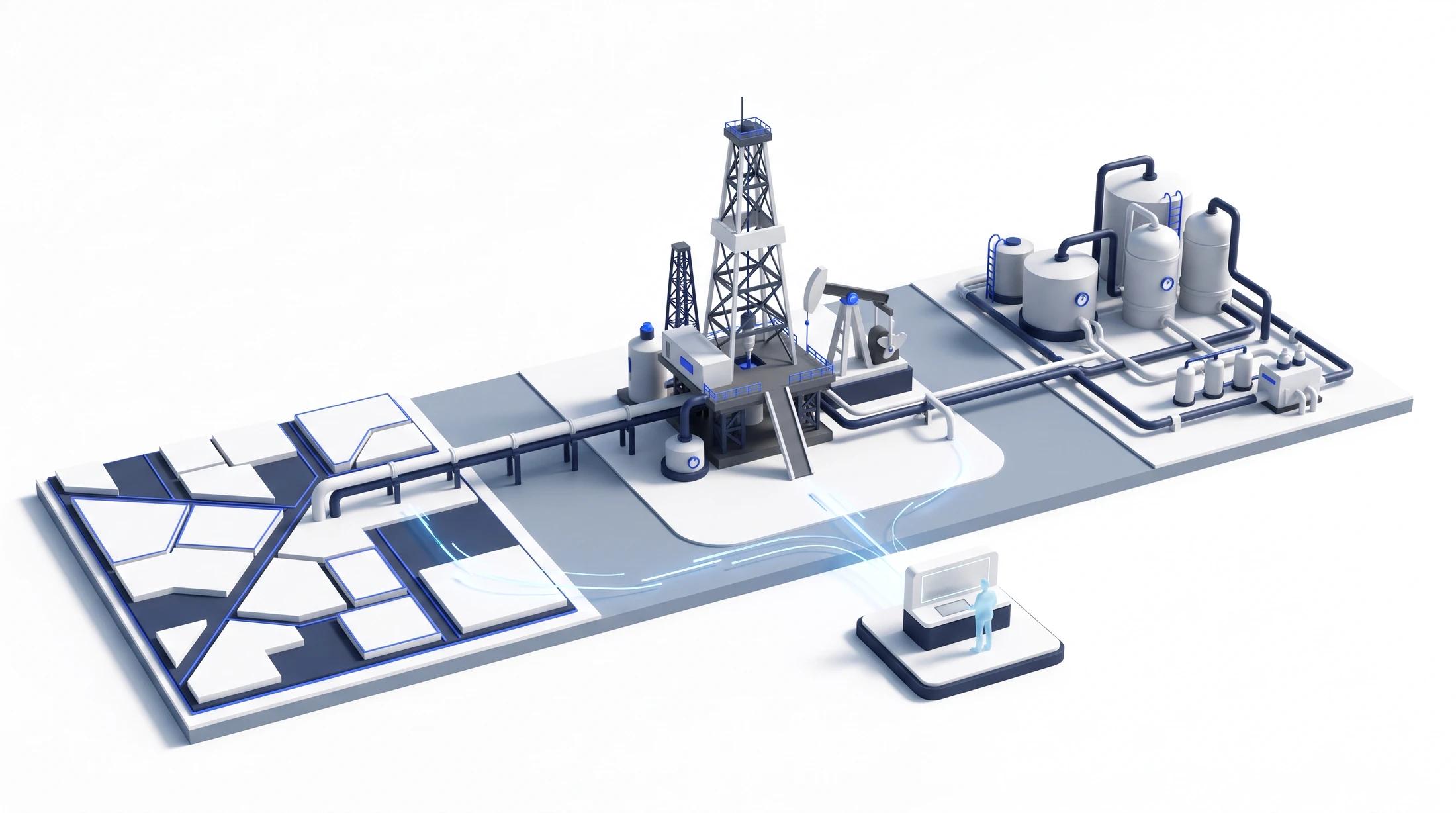
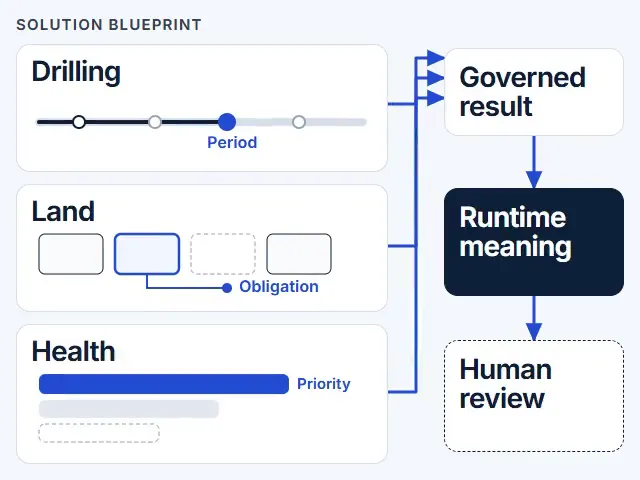
Three patterns, shown together. Each one reaches a governed result, then runtime meaning, then a person. They do not have to run in order. Example reference design, not a deployed system.
Start with the worked example
Two downtime records overlap on the same asset. Added together they count 4 hours, but the shared hour is counted once, so they cover 3 elapsed hours. Commercial exposure is not calculated until the business agrees how the shared hour is treated.
Worked example: overlapping downtime records
Worked example.
Equipment08:00–10:00
Weather09:00–11:00
Both
Union of supplied intervals — 3 elapsed hours.
Calculated from the example timestamps; operational meaning awaits review.
4 hours across two records
1 shared hour, counted once
Operations: validate what the records represent.
Commercial owner: establish allocation and applicable treatment.
Commercial exposure: not calculated.
Awaiting review
The three patterns below are reference designs: drilling performance and contracts, land and lease, and operational health.
How Energy connects to the business functions
Energy is an industry, not a sixth business function. An industry pattern applies the shared architecture to decisions specific to a sector, and one decision can span more than one business function. The links below connect each Energy decision to the functions its documented review involves.
Drilling performance and contracts
- Operations IntelligenceThe exception rule is an operations exception over well and time records.
- Finance IntelligenceA contract rate and cost categories make the exception a financial and commercial review.
Land and lease
- Operations IntelligenceObligations and dates are tracked as operational commitments.
- Finance IntelligenceAn interest calculation and a status change carry financial review.
Operational health
- Operations IntelligenceAsset and work-order records drive maintenance prioritization.
- Executive IntelligenceA prioritized list is read in a management review.
One pattern at a time
Each pattern uses the same Agentic AI Runtime and a separate human review. The runtime explains the governed result. It does not establish an executed Energy agent, invent a cause, or take the action.
Drilling Performance and Contract Intelligence
Maturity: Reference design
Which well-days or contract periods need review?
- Source categories
- Well operations, drilling time, contract terms, and cost categories.
- Governed result
- A review list of periods that meet an approved exception rule.
- Agentic AI Runtime interpretation
- Explains the declared period, contract terms, and rule fields, and proposes an exception. It invents no cause, rate, or comparison.
- Human review
- A person confirms the exception before it is treated as a finding.
- Inquiry
- Request a Strategy Session
See the overlapping-downtime worked example
Full reference design contract
- User
- A drilling-performance or contract analyst preparing a review, not an autonomous field system.
- Decision
- Which wells, rigs, or contract periods need a person to look before a performance or cost conversation.
- Source-data categories
- Example categories: well operations, drilling time breakdowns, contract terms, and cost categories. These are pattern names, not a named operator's system.
- Reporting grain and time
- A well or rig, by day or by contract period. The reporting period has to be declared before two periods are compared.
- Governed calculations
- Time classification, application of an approved contract rate, and an exception flag the business has already defined. The reference design does not publish a numeric threshold.
- Expected outputs
- A review list of periods that meet the approved exception rule, with the governing fields attached so a reviewer can see why the period was listed.
- Interpretation
- A business-facing agent may explain those governed fields in the Gemini Enterprise app. It may not invent a cause, a rate, or a comparison the rule did not produce.
- Missing data
- A missing time code, rate, or period stays missing and is labeled as missing. The model does not fill it in.
- Human review
- A person confirms the exception before it is treated as an operational finding or a contract claim.
Land and Lease Intelligence
Maturity: Reference design
Which obligations need attention?
- Source categories
- Lease records, obligation dates, ownership interests, and acreage status.
- Governed result
- An obligation queue with the governed status and the relevant dates.
- Agentic AI Runtime interpretation
- Restates the governed status, the parcel and obligation relationships, and both dates, and proposes a status change. It infers no ownership or satisfied obligation.
- Human review
- Land staff confirm a status change before it is the position of record.
- Inquiry
- Request a Strategy Session
Full reference design contract
- User
- A land or lease administrator tracking obligations and acreage positions.
- Decision
- Which leases, obligations, or acreage positions need attention before a date or a commitment passes.
- Source-data categories
- Example categories: lease records, obligation dates, ownership interests, and acreage status. No company's land file is used.
- Reporting grain and time
- A lease or tract. The obligation date and the as-of date are both stated. A status without an as-of date is not a current status.
- Governed calculations
- Date classification, an interest calculation the land team has approved, and an obligation status. Unpublished formulas are not implied.
- Expected outputs
- An obligation review queue that shows the governed status, the relevant date, and the fields the status was derived from.
- Interpretation
- The agent may restate the governed status and dates. It may not infer that an obligation was satisfied when the status does not say so.
- Missing data
- A missing date or interest is reported as missing. It is not estimated for the queue.
- Human review
- Land staff confirm any status change before it is recorded as the position of record.
Operational Health and Maintenance Intelligence
Maturity: Reference design
Which assets or work orders need review?
- Source categories
- An asset hierarchy, work orders, downtime categories, and maintenance history.
- Governed result
- A prioritized review list carrying the governed priority.
- Agentic AI Runtime interpretation
- Explains the governed priority and its fields, and proposes an item for review. It guesses no failure cause and completes no incomplete record.
- Human review
- Reliability staff confirm the item before a maintenance action is recommended.
- Inquiry
- Request a Strategy Session
Full reference design contract
- User
- A maintenance or reliability lead reviewing assets and work.
- Decision
- Which assets or work orders need review under the health and priority rules the maintenance function already owns.
- Source-data categories
- Example categories: an asset hierarchy, work orders, downtime categories, and maintenance history.
- Reporting grain and time
- An asset or a work order over a declared operating period. Comparisons use that same period.
- Governed calculations
- Downtime classification, a priority rule, and an overdue status. The reference design does not state a failure rate, an accuracy figure, or a savings estimate.
- Expected outputs
- A prioritized review list. Each row carries the governed priority and the fields that produced it.
- Interpretation
- The agent may describe the governed priority in plain language. It may not invent a failure cause or recommend a part.
- Missing data
- An incomplete work order or downtime record stays incomplete and is labeled. The list does not guess the missing category.
- Human review
- Reliability staff confirm the item before a maintenance action is recommended.
Proposed architecture
This is a proposed reference pattern. It is not a demonstrated Energy runtime, and it is not a claim that Alteryx, Google Cloud, or BigQuery endorses Orisdale. Gemini Enterprise app is the business-facing experience. The Agent Platform is the technical build and governance surface where that path applies. Orisdale's work in the pattern is decision design, semantic context, implementation, and validation.
- 01Enterprise operational sources
- 02Alteryx One governed preparation and business logic
- 03BigQuery governed analytical outputs
- 04Semantic Intelligence
- 05Gemini Enterprise Agent Platform, where a technical agent is built and governed
- 06Gemini Enterprise app for the business-facing experience
- 07Human review before an operational finding is treated as confirmed
Related pages: Google Cloud, Alteryx One, Architecture, and the Workflow Agent. Workflow authoring and this decision design are different pieces of work.
Questions buyers ask
What is the current scope?
Three documented designs: drilling performance and contract intelligence, land and lease intelligence, and operational health and maintenance intelligence. Retail and healthcare are not part of this page.
How mature is it?
Reference design. Each design states the user, decision, data categories, grain, calculations, outputs, interpretation limit, missing-data behavior, and human review. All three are proposed designs.
What data does it require?
The relevant operational categories named in each design, at a declared grain and time context. The page uses example categories. It does not include a company's records.
Where does a person review the work?
A person confirms an exception, a status change, or a maintenance priority before it is treated as an operational finding. The agent may explain governed fields. It may not invent a cause.
What is the next step?
Request a Strategy Session about one of these decisions. The session does not promise a result, a threshold, or a production date.